Something is wrong with this IPL.
Not wrong wrong. More like arithmetically off. The kind of wrong where you add up all the numbers correctly and still arrive at a number that shouldn’t exist.
Teams are posting 220. Teams are chasing 245. Jasprit Bumrah, yes *that* Bumrah, the one we have spent a decade being theatrically frightened of, is being hit for sixes. Matt Henry has been deposited in the stands. Arshdeep Singh, who once terrorized openers and gave entire stadiums anxiety, has become, on certain evenings, the man you place before a 15-year-old to see what happens.
What happens is not good. For the bowler.
Vaibhav Suryavanshi is 15. He is from Bihar. He bats left-handed. He has scored 400+ runs this IPL at a strike rate of 238. He has centuries. He has helicopter shots. He has, in the process of all this, made a grown man who plays professional cricket for a living look confused in public.
That man is Abhishek Sharma.
Abhishek Sharma is not a bad cricketer. Abhishek Sharma currently holds the Orange Cap. Abhishek Sharma bats at a strike rate of 212, which in any previous era would qualify him for sainthood or at least a government scholarship. But he watched Suryavanshi bat while fielding at Covers and reportedly had the expression of a man who has just discovered that the Grade 10 kid is appearing alongside him for his Master’s semester exam and completed the paper in the first hour.
That look. You know it. The one that says: I thought I was good at this.
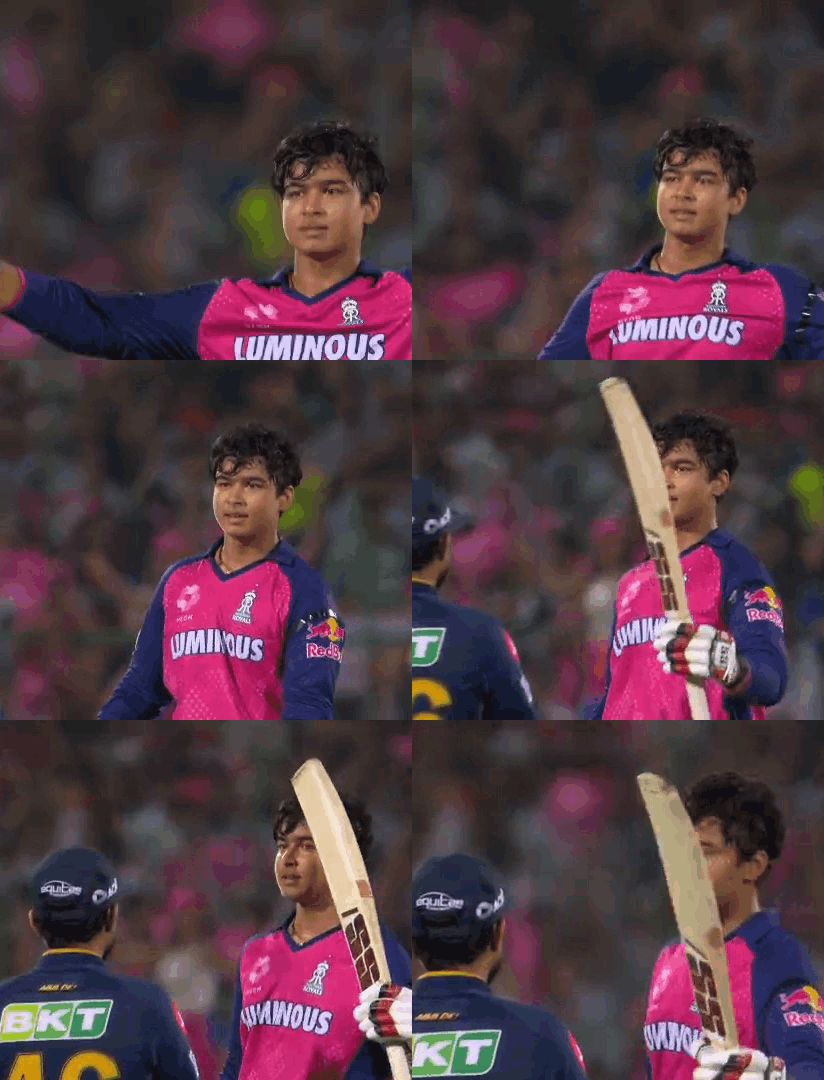
The IPL 2026 has a problem, which is that the batting has become so explosive that we have stopped noticing how extraordinary it is. 220 is now a below-par score. 250 is competitive. Cummins, Jansen, Henry, Arshdeep, Bumrah, a bowling lineup that reads like the final credits of a very prestigious cricket documentary, are collectively going for 10+ an over on evenings when the wicket is flat and someone has decided to have fun. Marco Jansen is 6’8″ and still got cleared over long-on. Nobody said anything. The match went on.
We have become numb to excellence. Or rather, we have recalibrated excellence so aggressively that it now requires a teenager to hit Bumrah for a hundred in 38 balls before we look up from our phones.
Samson is keeping wickets for CSK. Jadeja is doing at RR whatever Jadeja does, which is everything, quietly, at a level that makes you feel slightly ashamed of your own life choices. Hardik Pandya is somewhere in this tournament, being Hardik Pandya, which means he is either saving a match singlehandedly or not, and both possibilities are treated with the same collective mild interest India reserves for things it hasn’t fully decided to care about yet. Kohli is batting. ‘Nuff said.
These are the heroes. We have simply filed them under “obviously good” and moved on to the child.
And the child has no idea.
That is the most disarming thing about Vaibhav Suryavanshi. He is not performing confidence. He is not doing the Rohit Sharma lean-back-and-watch-it-land routine with self-conscious awareness of the camera. He is fifteen. He hits the ball because the ball is there. He plays the helicopter shot because Dhoni plays it and he watched Dhoni play it and it seemed like a reasonable thing to do. He does not know that you are not supposed to play the helicopter shot against Arshdeep Singh in a match that matters, because nobody has taught him yet that the shot is reserved for legends and farewell appearances.
Someone will teach him. Give it a year.
Speaking of Dhoni.
Mohit Sharma, on Cricbuzz, not the bowling Mohit Sharma, although at this point I wouldn’t be surprised if the bowling Mohit Sharma also had opinions, said that Vaibhav is only the second player he has seen command the same aura as Dhoni across all ten franchises, all ten grounds, opposition players, commentators, cameramen. Everyone wants to speak to him. Everyone turns to look.
This comparison is both the greatest compliment a cricket-watching nation can give and, if you are fifteen and would like to simply score runs and go home and do your maths homework, a fairly significant burden to place on someone who has not yet sat his board exams.
But India does this. We cannot watch someone exceptional without immediately searching for the vessel we have been keeping empty. The day we saw Tendulkar bat for the first time, someone in the crowd quietly retired the word “Gavaskar.” We do not mean harm. We just cannot tolerate a greatness without a predecessor. It unsettles us. Continuity is our primary coping mechanism.
Dhoni, for his part, is sitting on the CSK bench with a calf injury that can be felt on the nation’s brow.
He has been net practicing. Which is Dhoni’s way of saying several things simultaneously: that he is coming back, that he is not coming back, that he will arrive when he decides to arrive, and that the entire question is frankly not your business. He manages the expectations of CSK’s fanbase, which is essentially a small country with yellow jerseys, by being visible enough to prevent panic and unavailable enough to prevent certainty. It is not a strategy. It is simply who he is.
Rajinikanth said it best in Muthu, in that way Rajinikanth says things that immediately become applicable to every subsequent situation in Tamil Nadu and several situations in Bihar: Na eppo varuven, epdi varuven-nu yaarukkum theriyaadhu. Aana varavendia nerathula correct-a varuven.
No one knows when I’ll come, how I’ll come. But I will come when the time is right.
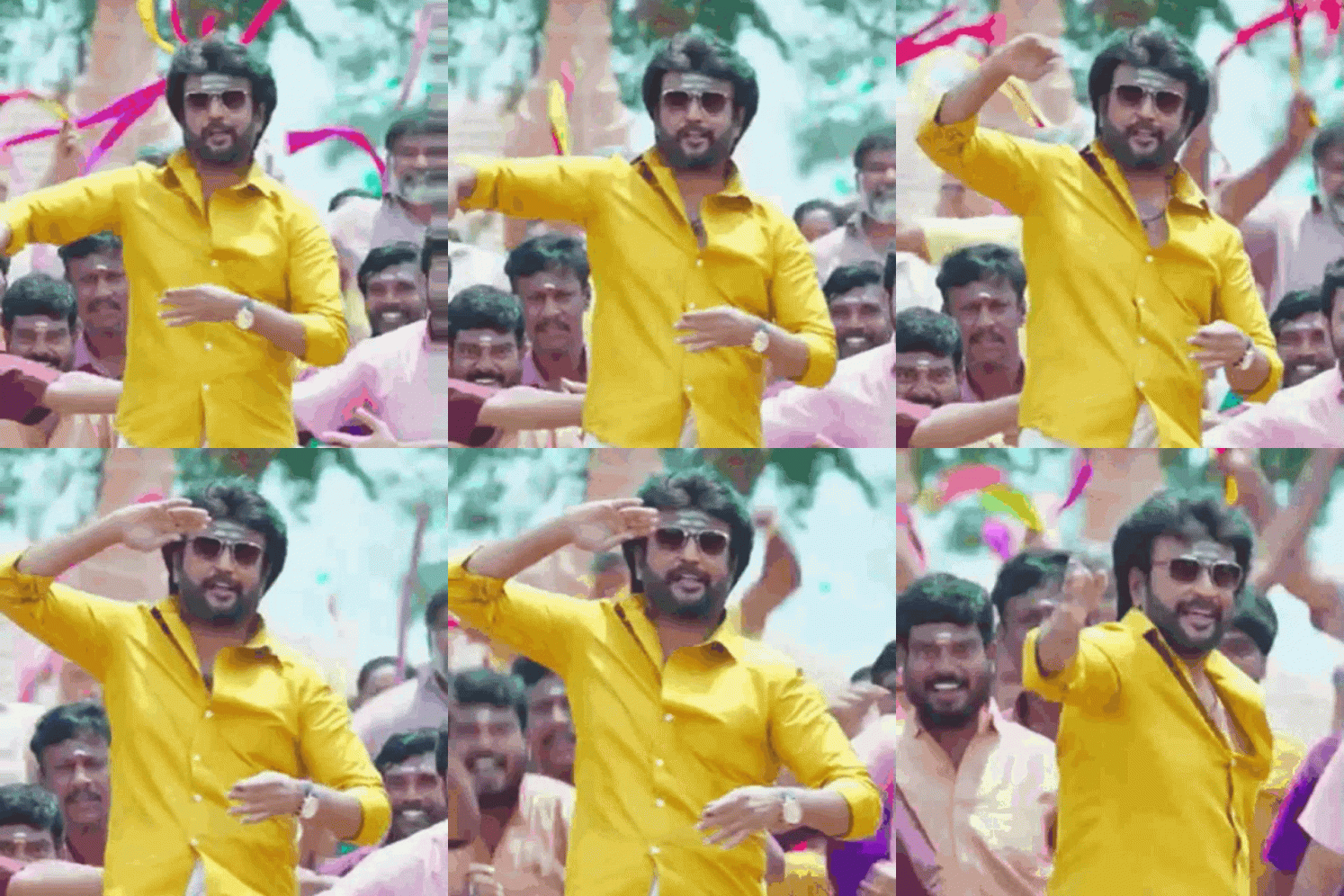
Dhoni has been running this dialogue since 2020.
The thing about Dhoni and exits is that he has made a philosophy out of not announcing them. His Test retirement happened on 30th December 2014, during a drawn match in Melbourne, after which he picked up a stump, walked off quietly, and told no one. R. Ashwin found out in the hotel room that evening. Suresh Raina, Dhoni’s closest friend in the team, found out when Dhoni walked up to him and asked him to take a selfie, because Dhoni was not going to wear that white jersey again and wanted a photograph with someone who would understand. Raina was not expecting it. Raina cried. Dhoni wore the Test jersey the entire night.
There was no press conference. No farewell lap. No coordinated Instagram post with a tasteful black-and-white filter. The BCCI released a press note. The series continued. The world adjusted.
He retired from all international cricket the same way, on August 15, 2020, Independence Day, via Instagram, while a pandemic kept everyone at home. Suresh Raina retired the same day, minutes later. Which is very them. Even retirements, they did together, without telling anyone first.
This is a man who has conducted every significant exit of his life the way Richard Parker exits in Life of Pi. The tiger who shares the boat, saves the boy, survives the ocean, and then simply walks into the forest at the edge of the beach without looking back. Pi waits for something. A glance. A gesture. Some acknowledgment of what they went through together.
The tiger does not look back.
The tiger is not being cold. The tiger is just done. Done in a way so complete it does not require ceremony.

Meanwhile, RCB.
We should give them their credit. Not because they have earned goodwill, exactly, but because fairness is a virtue even when applied to institutions that have tortured their fanbase for seventeen years. RCB’s bowling in IPL 2026 is genuinely the best attack in the tournament. Bhuvneshwar Kumar and Josh Hazlewood are operating at a level that feels almost rude in this tournament’s general context. They bowled Delhi out for 75. Hazlewood took 4/12. Bhuvi took 3/5. Delhi had scored 264 against Punjab two days earlier. Bhuvi has just become the first fast bowler to take 200 IPL wickets. He has been doing this since 2013.
In an IPL where standard bowling figures are 0/52 and the post-match analysis is “it was a flat track,” Bhuvneshwar Kumar deciding to bowl cutters into the base of off stump feels radical. Almost an act of protest. RCB’s bowling attack is the only reason, in 2026, to feel philosophical about defending totals.
So yes. RCB’s bowling is good. We said it. It will not be mentioned again.
What we are really talking about, when we talk about Vaibhav Suryavanshi, is not the runs or the strike rate. We are talking about something that happens once in a long while in Indian cricket: a person who plays the game as though he has not yet been told what it means. Before the weight of the country gets onto his shoulders. Before the comparisons calcify into expectations. Before someone sits him down and explains, carefully, what Dhoni means to people.
He is in that window right now. The brief window before the narrative machine fully boots up.
In it, he is just a boy from Bihar who hits the ball very, very hard, watches it go, and feels no particular way about it.
India, predictably, feels every possible way about it.
 comically
Leave a comment