We were trying to wish Ammamma.
Ammamma was turning eighty-something. The family had decided, as families do, that a collective birthday video from all the grandchildren and great-grandchildren would be the showstopper this year. My wife is one of those grandchildren. And my contribution to this warm family project was to be the good boy husband to my wife’s making of the clip—even though Ammamma is right here. Watching TV. Upstairs.
We had a recent picture of my wife and me taken at a restaurant lobby. It had good lighting and two people who looked like they deserved to be in a family video. And I thought, Why record a new video when a picture exists and AI can weave it into a venerable clip?
So, I handed the picture to Veo, Google Gemini’s video generator, and asked it to do what I was too comfortable to do myself. Forty seconds later, it gave me a video of my wife and me wishing Ammamma happy birthday.
Almost.
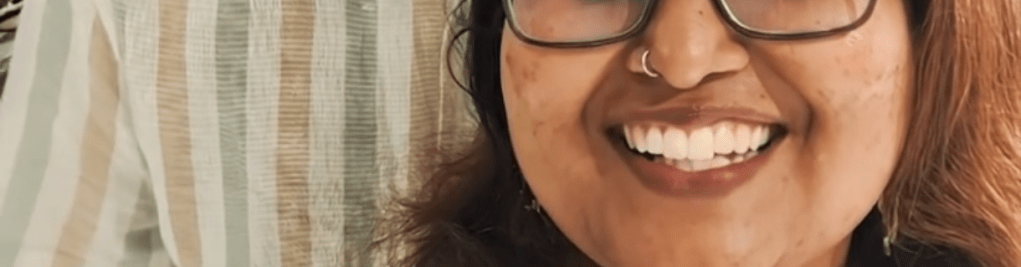
My wife’s hair was right. The face was structurally convincing. But her smile—the specific arrangement of her teeth and warmth I had known for nineteen years—belonged weirdly enough to her sister-in-law.
The machine had seemingly surveyed the gene pool and returned with the smile of a cousin’s wife, no less on the other side of the family. Randomly and deliberately, at the same time. With the quiet confidence of an entity that has studied your family tree and formed opinions on whose smiles must be selected to survive.
My wife watched it once and said: that is one psychopathological me.
She was right. We could not send it to Ammamma.
We went to the front yard. Recorded the greeting ourselves. In the sun. Which, curiously enough, is what I had been trying to work around. Technology, after all, is mostly a scenic route to the obvious and the practical.
—
Here is the thing about humans and the impossible.
We have always worshipped the impossible.
When Moses parted the Red Sea, nobody said: interesting, let us examine the meteorological conditions. They dropped everything and followed. When Ram’s foot touched a stone and Ahalya walked out of it, nobody questioned the geometry. When Ram needed a bridge to Lanka and stones floated because they carried his name, no marine engineer was consulted. When Lazarus walked out of his tomb four days later, nobody filed a complaint about the delay. When water became wine at a wedding, the guests did not ask for the recipe. They simply noted that this was not the caterer they had expected and adjusted accordingly.
Miracles have one major rule of thumb. They do not approximate. They merely outlive their probability.
Lazarus did not come back mostly. The sea did not part enough that you could cross if you committed. The wine was not wine-flavoured. Ahalya did not emerge partially, with her sister-in-law’s jawline. The stones did not almost float. The miracle arrives completely or it is not a miracle. It is weather.
We built civilisations on this grammar.
And then, because we are a wonderfully consistent species, we took the exact same grammar to the cricket ground. When Kohli put the short ball from Rauf behind the sight screen, our gooses were bumped. We roared. We call it the Shot of the Century. Kohli had not parted a sea. But he has violated what we believed nature permits, and something ancient in us files that under the same heading of godhood. Rajnikanth is a miracle with a screenplay. The politician who wins against all odds is a miracle with a campaign manager. We know the machinery. We stand and roar anyway.
We worship exceeded probability. We always have. We have simply, over the centuries, changed the venue.
By this definition, what Veo did with our couple’s selfie from the restaurant was miraculous.
A flat image, no depth, no history, no record of how this face moves when it means something—and yet forty seconds later, a speaking, moving, nearly-correct human being emerged from it. In another century this would have required a priest and a seance, not a phone.
And yet we laughed.
Not in awe. Not out of reverence. The specific laughter of watching something reach for the divine and return with their sister-in-law’s teeth.
Why?
Because every miracle in the history of the impossible had someone behind it who could not afford to fail. Veo had nothing to lose. It only approximates the probability it was trained to predict.
You cannot worship something which is not aware it just performed divinity.
And then we explained it. Neural networks. Training data. Statistical inference. The miracle arrived with an instruction manual. Gods have always lived in the gap between what happened and what we could account for. This one closed the gap itself, immediately, without being asked to.
We do not have a theology for a miracle that is an eight out of ten on the cosmic scale.
We have memes for it.
—
Nineteen years.
I know this face across every lighting condition a marriage produces. I thought I knew it completely. The machine looked at her once and decided that her jawline needed an upgrade we did not ask for.
Thou shall inherit thy sister-in-law’s smile for no reason.
—
Ammamma got her video. Recorded in sunlight, by two people who had briefly tried to outsource a gesture that can never be outsourced. We live in a time when miracles are generated at scale, filed under productivity, and occasionally never sent to grandmothers with someone else’s smile.
The older gods demanded belief. This one demands RAM and lot of water.
And the question it leaves behind is a simple one.
Who is getting whom slightly wrong?
The machine, which makes a miracle look like a failed magic trick. Or the miracles that worked as magic tricks because nobody, in the entire history of their telling, ever thought to check the teeth.
 comically
Leave a comment