A rewriting of the paper.
The brain is a kilogram and a half of bioelectric irony.
I say this as someone who spent forty minutes this morning deciding whether to have coffee before or after a walk, and concluded, with full conviction, that the order mattered cosmically.
The prefrontal cortex, which I had been crediting with this elaborate deliberation, is not a palace of reason. It is a policy office of probability. It drafts strategies for survival the way ants draft pheromone maps: instinctively, recursively, without knowing it is doing it. The decision about the coffee was made approximately three seconds before I thought I made it.
The deliberation was the brain flattering itself.
Spinoza called the unity of existence Deus sive Natura. God, or Nature. The twenty-first century update is Deus sive Neuron. Same bureaucracy, better branding.
This is where it gets uncomfortable.
If the brain is the demiurge, the thing that generates reality, meaning, morality, taxonomy, love, and the compulsion to correct strangers online, then everything downstream of it inherits its architecture. And the brain’s architecture is a network: nodes firing in patterns, patterns reinforcing themselves, contradictions buried in the filing system rather than resolved.
Scale that up.
Governments are neural habits pretending to be moral systems. Mobs are lateral inhibition rendered in bodies: communities firing in opposition to heighten contrast, exactly as neurons do. Left, right, far right, the group chat that started about logistics and somehow became about identity, all of it is the brain’s electric politics, externalized.
The human population is a fractal expansion of the neural network that made it.
I find this both clarifying and deeply annoying, because it means that every argument I have ever had online was not a philosophical exchange but a synaptic event. The other person was not wrong. They were firing differently.
This does not make me more tolerant. It makes me tired in a more informed way.
Here is what the brain does with its own contradictions: it buries them. Not resolves. Buries. It builds comfort architecture. Taxonomies that make randomness look habitable. The categories feel like discoveries. They are, in fact, interior decorating.
Nietzsche said truths are worn-out metaphors, coins whose images have faded through overuse. Kant said what we perceive is not the world as it is, but as our faculties can manage to describe it. Churchland went further and suggested that even “belief” and “desire” are fictions of folk neuroscience, placeholder concepts for processes that have no use for our names.
The knower itself is a performance of survival.
Which means knowledge is not discovery. It is what leaks out when neurons negotiate among themselves and one of them writes it down and calls it an insight.
I have several insights per week. I am now less sure about all of them.
Language was supposed to be the solution. The shared system that gets us out of our separate skulls and into something mutual. But Saussure said the sign is arbitrary. Lacan said it alienates the subject from the start. McLuhan said the medium is the message. Put all three together and you get: the brain is both medium and message, emitter and interpreter, sign and signified.
Every word is the brain flattering itself in a slightly different font.
Including this sentence.
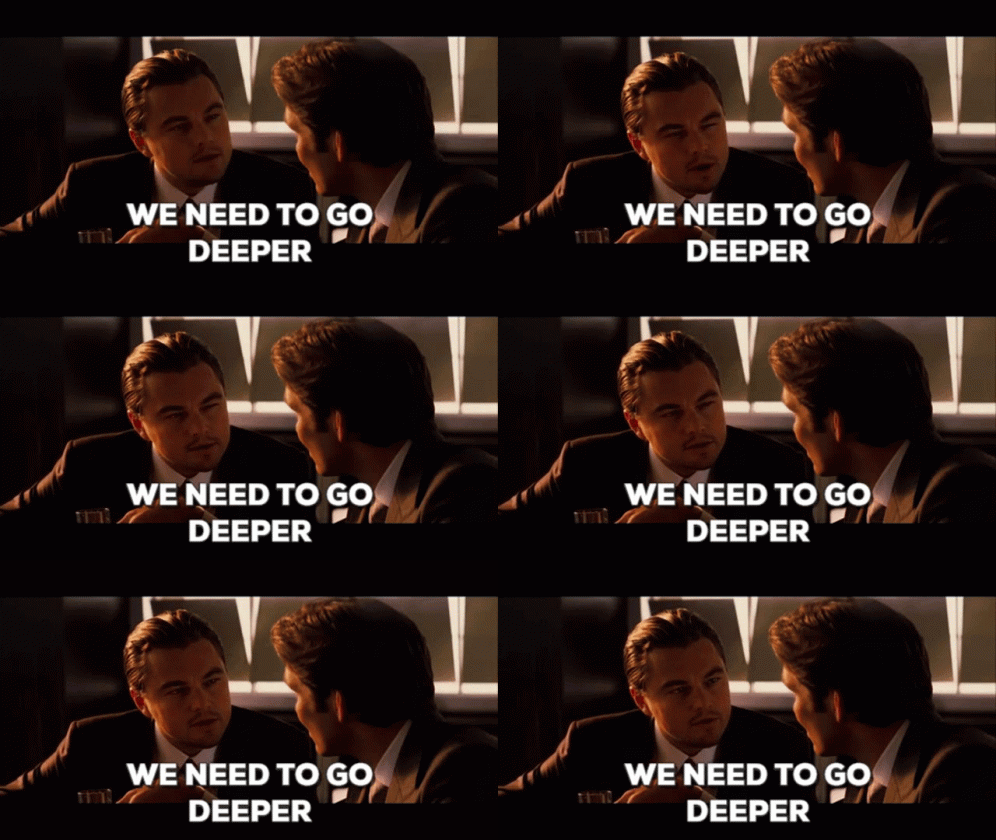
The question that remains, the one I cannot file away, is what you do with this. If the brain is god and the self its hallucination, if every moral conviction is an adaptive story and every insight is evolutionary collateral, what is left?
The Stoics had an answer. Not a comfortable one.
Amor fati. Love what is. Not because it is good, not because it is just, but because it exists, and you are made of it, and the alternative is spending your one confirmed life arguing with the neurology.
The Stoic smile is not wisdom. It is the neuron’s way of saying: I know what I am. I have decided to find it interesting rather than catastrophic. This is the only remaining virtue I can locate with any confidence. Lucidity with grace. To see the machinery, the fractal brain, the scaled-up synapses, the comfort architecture, the coins with faded images, and still find it, somehow, worth describing.
The brain fires.
The man writes.
The essay explains itself.
The brain applauds.
What is your theory of the brain? Leave your thoughts in a comment.
 comically
Leave a comment