By Lakshmi | life and reflection—funny side up
The year is 1859. Bernhard Riemann walks into the mathematical equivalent of a dive bar, drops a seven-page paper titled “On the Number of Primes Less Than a Given Magnitude”, mutters something about “non-trivial zeros,” and leaves. Mic not dropped—because they didn’t have mics. But if they did? Broken.
Inside that paper was a line. Not a metaphor. A literal vertical line in the complex plane. Real part equals 1/2. And Riemann casually suggests that all the interesting zeros of his zeta function live exactly on it. Not near it. Not sort of adjacent. Exactly on it.
And thus began the longest-running reality show in math history:
Keeping Up with the Non-Trivial Zeros.
—
Why Should You Care?
Because these zeros know where the prime numbers are hiding.
Let me explain like we’re all drunk on filter coffee:
Prime numbers are messy. No pattern. No loyalty.
But when you study the zeta function, suddenly there’s structure.
The zeros of the zeta function influence how primes are spread.
If every zero behaves — stands on that 1/2 line like a disciplined boarding schoolboy — then the distribution of primes is “as regular as it can mathematically get.”
If even one zero strays off that line?
The entire theory of prime distribution develops anxiety.
Number theory becomes approximate. Cryptography gets nervous. Mathematicians get ulcers.
—
The Cult of the Line
So far, we’ve found billions—trillions—of zeros. All obediently on the line.
Mathematicians are like that aunty at every wedding:
“I’m not saying I don’t trust the bride, but we must run one more background check.”
Because unless someone proves the Riemann Hypothesis, we’re still in the dark. Every major advance in number theory today is like a building made on land where the title deed is under dispute. Everything works, yes, but there’s always the risk that someone will find a zero off the line — and we’ll all have to move out.
—
Who’s Tried to Prove It?
Everyone. Hilbert. Hardy. Littlewood. Turing.
Even AI is now swiping right on Riemann. No one’s cracked it. But lots of people have almost cracked it. Which is mathematician-speak for: “I had an emotional breakdown while holding a chalk.”
Meanwhile, Riemann is up there, sipping espresso in whatever afterlife mathematicians go to, going,
> “I just said I think they’re on the line. Y’all did the rest.”
—
So, What’s the TL; DR?
The Riemann zeta function connects to the distribution of primes.
The non-trivial zeros of this function tell us where primes are “likely” to occur.
If all zeros lie on the line, the primes behave nicely.
If any zero doesn’t? Number theory becomes a soap opera.
—
Final Thought (with Lakshmi Flare™️):
The Riemann Hypothesis is like India’s moon mission:
We know it should land safely.
We’ve simulated it thousands of times.
But until it actually touches down and someone proves it, we’re all just holding our breath and refreshing Twitter.
And the zeros? They’re already there.
Quiet. Balanced. Equidistant between madness and meaning.
Like all good truths.
They wait.
—

Wait. Rewind. What’s a Zeta Function?
Take a breath. This won’t hurt.
The Riemann zeta function is a magical infinite series:
\zeta(s) = \sum_{n=1}^{\infty} \frac{1}{n^s}
\zeta(2) = 1 + \frac{1}{4} + \frac{1}{9} + \frac{1}{16} + \dots = \frac{\pi^2}{6}
But things go off-script when you let be a complex number:
s = \sigma + it
What this actually looks like:
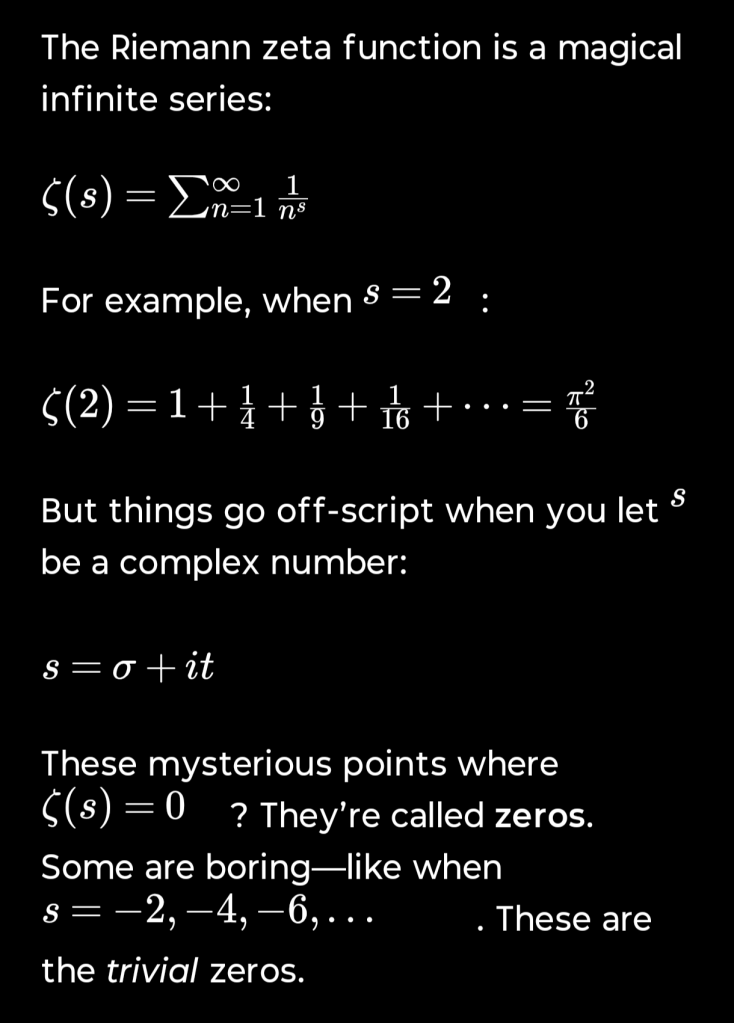
These points where ? They’re called zeros.
Some are boring—like when . These are the trivial zeros.
But the juicy ones, the non-trivial zeros, are the ones Riemann was talking about.
And his bold claim?
> Every single non-trivial zero lies on the line .
No exceptions. No freelancing. No DeLullo.
—
 comically
Leave a comment